
The Middle Distance
What Evolution Never Built Me to Do
On my 27” monitor, it’s still hard to get two spreadsheets up at the same time. With my computer glasses on, I’m struggling to fit the headers and rows where I need them, to see what I need to see. After hours of staring, I can feel the grit building, every blink a windshield wiper made of sandpaper.
At the ophthalmologist a few years ago, I’m in the chair while he installs tiny plugs into my tear ducts. He extends the tongs, the plugs pinched at the end, his hand shaking, his other hand holding my eyelid open. Dry eyes are common at my age, he says — oil glands clogging, fewer tears, a fixed gaze eighteen inches from a lit screen. The last time my eyes failed me I was in the fourth grade, putting on distance glasses for the first time, the world snapping sharp. So sharp I could see every pore on my mother’s face.
And now I have computer glasses too. Reading and distance glasses became a thing a few hundred years ago. Computer glasses are more recent — a recent invention for a recent problem. Before screens, two options solved all of our problems. Who, in their right mind, would choose to stare at a fixed point eighteen inches away, at a bright screen, for hours, day after day, year after year?
When you expose the eyes to screens long enough, they adapt — just not in the ways you’d want. Blink rate drops to roughly a third of normal, from fifteen or twenty a minute down to six or seven. The eyes stay full-open, fixed straight ahead, evaporating twice as fast as they would behind the downward gaze of someone reading a book. For developing eyes — kids, young adults — the eyeball itself can lengthen into myopia. Turns out natural sunlight blasts the eye at ten thousand lux, triggering the retinal dopamine that keeps the eyeball from growing too long; indoor light manages maybe five hundred. Computer glasses make possible what evolution never built my body to do — stay transfixed, staring at one spot, indefinitely.
But a world without screens? I don’t need glasses to see that’s not happening. So is there an answer that doesn’t come down to each of us blinking more and getting outside more? The real fix is structural: a work culture that doesn’t require constant screen time. COVID showed it’s possible — companies backing a more varied workday — though that version was missing the people.
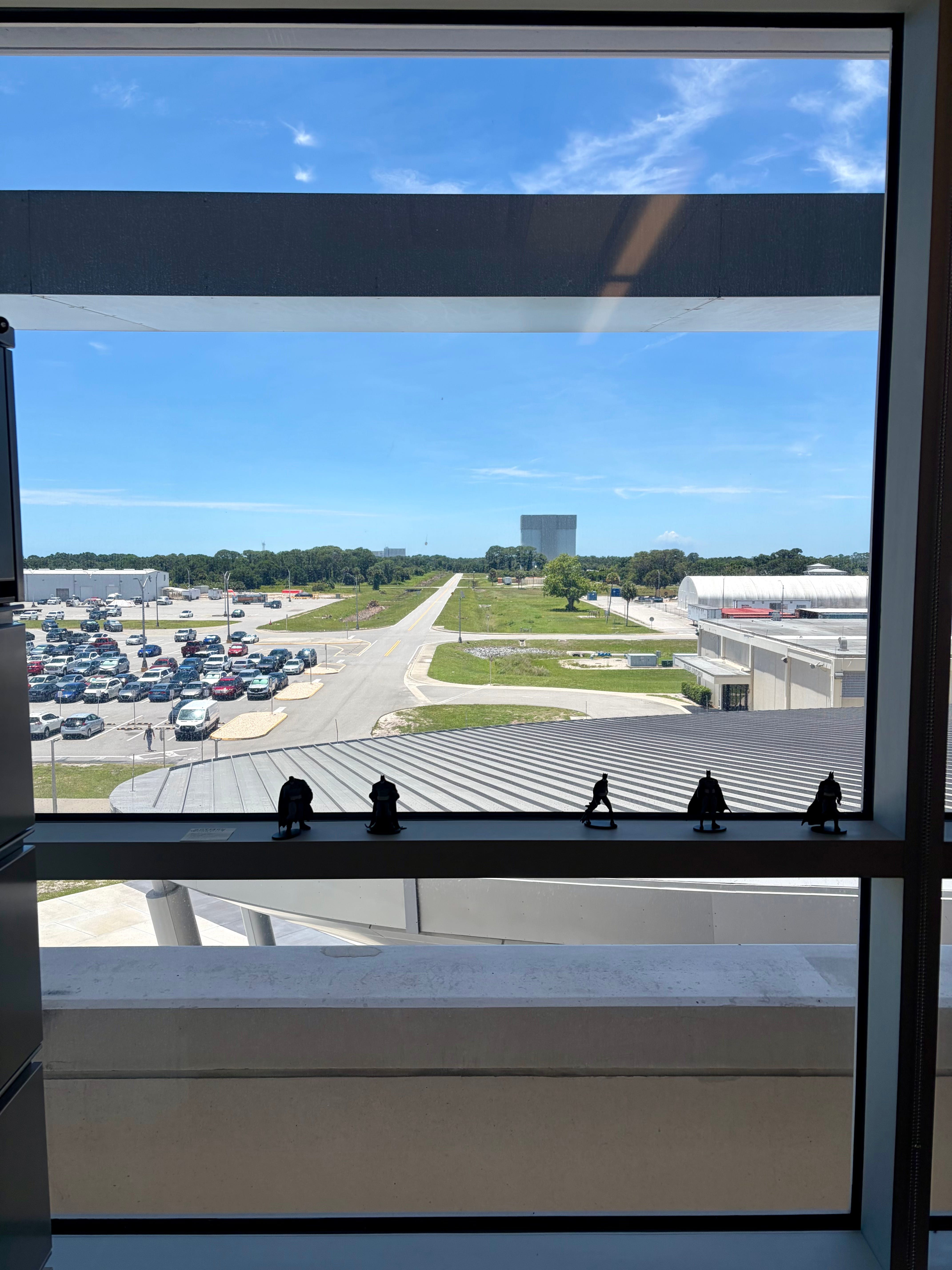
Yet here I am on the third floor of a seven-story building, wasting a floor-to-ceiling window because I’m turned the other way, toward the monitor. This morning brought something unexpected. A coworker steps in to tell me there’s an alligator crossing the parking lot. We go to the window and take in twelve feet of prehistoric animal that doesn’t seem to know, or care, that it’s trespassing across an urban landscape built by technology. A commotion gathers below, people drifting out with their phones up. My coworker goes to join them. I hang back, a pane of glass between me and the wild — close enough, through it, to see the ridges down the animal’s back, too clearly. Then I put my computer glasses back on, crack my knuckles, and return to the spreadsheet.
POSITIVE AFFIRMATION
“I was holding my baby girl this morning. I was wearing my computer glasses but at that distance, I didn’t need them, so took them off. And every so often, if I get lucky, I’ll catch her gigglig in her sleep. Truly, one of the most amazing sights in my life.
Today I am finding those moments where I can giggle awhile awake.”
- from my AffirmStreak this morning
The description of the treatment on your eyes made me feel like I was there! On a note, though, more about the message of the post, I agree that the changes we can have are structural. It is possible for us to have a world with less screen time and more balance.