
The Invisible Foundation
What My Spreadsheet Doesn't Show
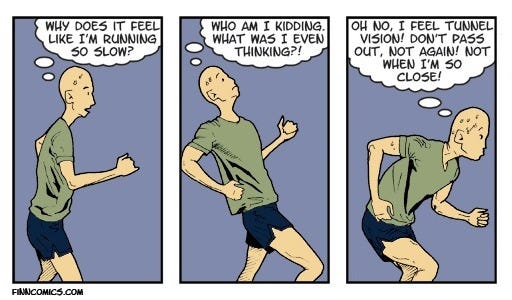
Geez, my legs feel heavy. I’m not even one mile into the run and thinking, “this is gonna be harder than I thought.”
It’s 4PM and I’m at a local park, going for an easy run after a day in the office. I’m at the tail end of my latest sickness, courtesy of daycare germs, and have been doing low-intensity, short workouts to help clear out the gunk and get my blood circulation going. But at this moment, I am thinking how I used to run 9-minute miles a few years ago but now I’m averaging 11-minute miles, and running way less too. Is this the inevitable mid-40’s decline?
The frustrating piece is that I’ve done my research. Dynamic stretches beforehand, static stretches after the run, toss in a few A-skips and pogo jumps too. But still, 11-minute miles and heavy legs.
A part of me knows it might be because I’m still recovering from being sick these past couple weeks. Heck, I just read Pontzer’s Burn and the thesis is how we have a constrained total energy budget and when we’re sick, more of that energy gets devoted to the immune system, and less for physical activities. In other words, my body was doing its job of recovering first, running faster later. But that energy redirect doesn’t exactly explain the last few years…
And so, when I recall what was different, a few years ago, during COVID, I was working remotely. I made it a point to do 100 pushups, spread throughout the day. I’d take calls while walking around the neighborhood. My lunch breaks were actually 30 minutes with Yoga with Adriene, where I completed her 30-day challenge. By the end of the workday, it was time to lace up my shoes and go for a long run. The point is, I was pretty darn active throughout the day.
Throughout the years, from COVID to today, I still exercise most days of the week. Sure, the duration and intensity might’ve dropped a little with the introduction of kids, but I was still doing interval runs, strength training, yoga, etc. But something my spreadsheet doesn’t show is all of the inactivity. Now, back in the office but still on video calls all day, I’m a prisoner in my office. With less opportunity to walk around — and apparently frowned upon to do yoga in my short shorts in the break room — I don’t move around as much. So, even though I was still training to be in peak physical shape, I was ignoring the foundation.
And when it comes to running, the foundation is literally your feet. The Achilles tendon is your spring that powers each step, storing bits of elastic energy that then get released to propel you forward. Those springs were more responsive a few years ago, but without maintenance, they stiffen. It took a few years of inactivity to ruin my foundation, resulting in a declining running pace. Good news is that plyometric-type movements, such as jumping, help retrain the tendons. A 2024 study of middle-aged recreational runners found that 10 weeks of twice-weekly plyometrics improved running economy by 2–3.4%. That might not sound like much, but every one-percent improvement adds up.
So, I’m changing my daily protocol. For at least four weeks, I’m adding a 10-minute walk after every 90 minutes at my desk, and introducing two short plyometric training sessions per week. I’ll keep my runs the same, so I can compare and see if there are any changes. Stay tuned, I’ll report back on what happens.
POSITIVE AFFIRMATION
“I’m lucky my body can move as well as it does. One day, if I live long enough, I may not be able to run anymore, bike anymore, or even get up from a chair by myself.
Today I am thankful for the ability to move.”
- from my AffirmStreak this morning
Trying to work out more to